Tuesday, October 7, 2025
DSP Shows presents Stereolab live in Asbury Hall with support from Dorothea Paas
7pm Doors, 8pm Show
Tickets: ON SALE 2/28 @10AM EST – General Admission Standing for $35 advance, $40 day of show, can be purchased at at TixR.com or the Babeville Box Office (M-F 11a-5p) with no fees for cash transactions, 3% credit/debit card fee. Limit 4 per person, ages 12 and over, patrons under 16 must be accompanied by an adult.
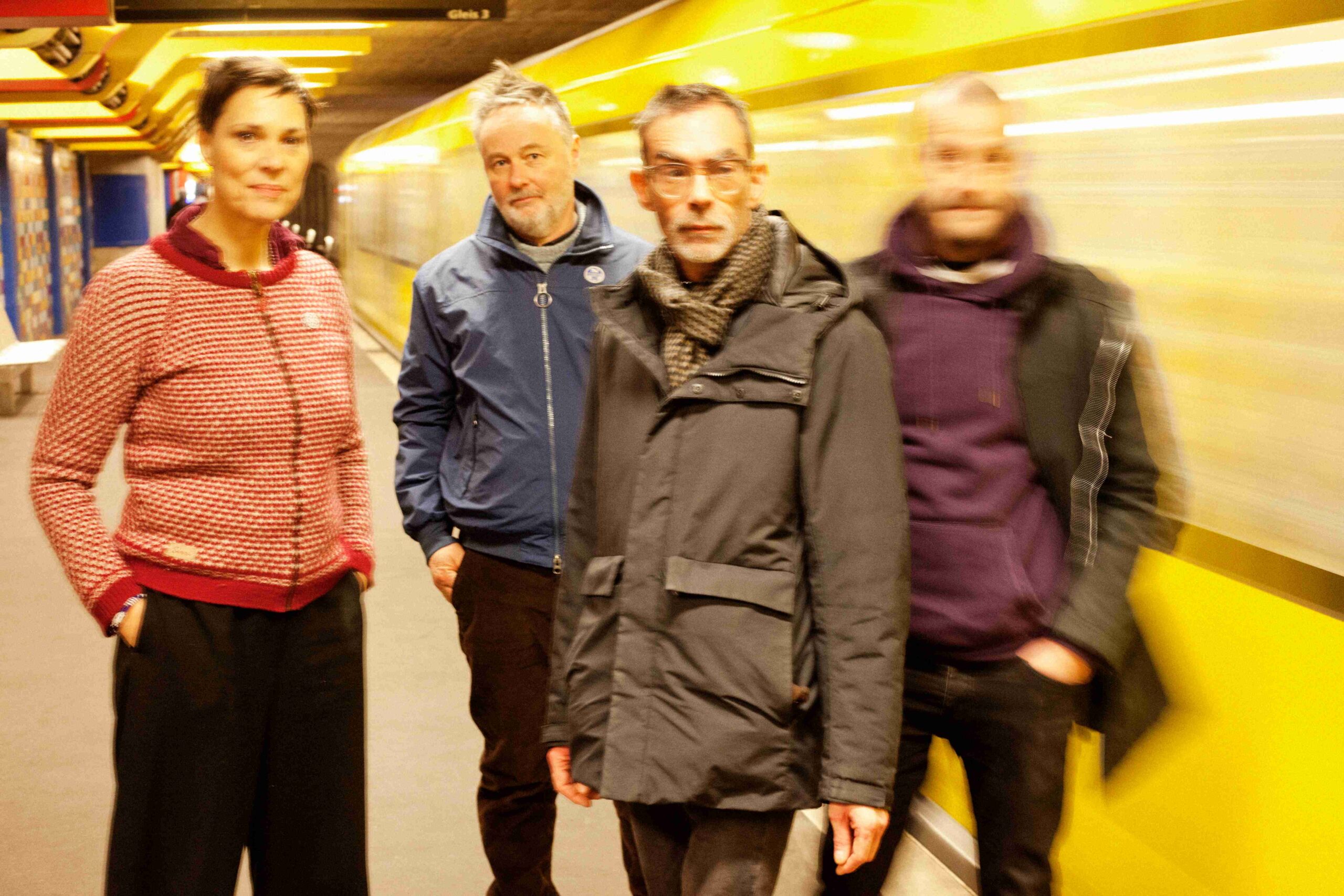
With their hypnotic rhythms and mesmerizing vocals, Stereolab became one of indie’s most distinctive and influential bands when they emerged in the early ’90s. Led by Tim Gane and Laetitia Sadier, the group celebrated strands of pop music — bossa nova, lounge-pop, movie soundtracks — that were traditionally banished from rock’s lineage. On early singles and albums such as 1993’s Transient Random-Noise Bursts with Announcements, Stereolab combined ’60s pop melodies with an art rock aesthetic borrowed from Krautrock bands like Faust and Neu!; by the time of 1996’s Emperor Tomato Ketchup, their sound incorporated jazz, hip-hop, and dance music. Their work with John McEntire and Jim O’Rourke on 1997’s Dots and Loops and 2001’s Sound-Dust reflected an increasingly intricate, experimental approach, but following the 2002 death of member Mary Hansen, they eventually returned to a poppier style on albums like 2008’s Chemical Chords. Stereolab’s unmistakable sound had a lasting impact: Contemporaries like Pavement and Blur aped their style in the ’90s, while hip-hop artists such as J Dilla and Tyler the Creator sampled the band’s music or collaborated with its members in the 2000s and 2010s. Late in that decade and into the 2020s, Stereolab’s revival as a touring band and a steady stream of reissues underscored their reputation as innovators. Tim Gane (born July 12, 1964; guitar, keyboards) was the leader of McCarthy, a London-based band from the late ’80s that functioned as a prototype for Stereolab’s sound. Gane met Laetitia Sadier (born May 6, 1968; vocals, keyboards), a French-born vocalist, at one of McCarthy’s concerts. The pair began a romantic relationship that became a musical collaboration after McCarthy disbanded in 1990; Sadier sang on the final McCarthy album. The duo began recording as Stereolab, borrowing the name from Vanguard Records’ hi-fi effects division in the ’50s. Gane and Sadier also formed the label Duophonic Records with manager Martin Pike to release their singles. Stereolab’s first year of existence was prolific: The debut EP Super 45 arrived in May 1991, followed quickly by the Super-Electric EP that September and the Stunning Debut Album EP that November. At that point, the group were working with Th’ Faith Healers drummer Joe Dilworth and former Chills bassist Martin Kean; Gina Morris occasionally provided backup vocals. Too Pure released the band’s first full-length, Peng!, in May 1992, and the EP compilation Switched On in October. As with all of the group’s releases from this era, both albums featured the visual trademark of a maniacally grinning cartoon taken from a ’70s Swiss political comic (which the band named “Cliff”). That year, Stereolab also issued the Lo-Fi EP and added keyboardist/vocalist Mary Hansen and drummer Andy Ramsay to the fold. Released in early 1993, Stereolab’s The Groop Played “Space Age Bachelor Pad Music” EP featured the core group of Gane, Sadier, Hansen, and Ramsay, along with ex- Microdisney guitarist Sean O’Hagan and bassist Duncan Brown. One of the first ’90s alternative records to explicitly draw from the “Space Age” lounge-pop music of the ’50s, The Groop became an underground sensation, paving the way toward Stereolab’s first American record contract with Elektra Records. Their next album, and first American release, was Transient Random-Noise Bursts with Announcements. Released in August 1993, it became an underground and college hit throughout the U.S. and U.K. They followed it that October with Crumb Duck, a split EP with Nurse with Wound. Early the following year, the Jenny Ondioline EP became Stereolab’s first charting release when it entered the U.K. Singles chart at number 75. Stereolab soon became a hip name to drop for many musicians, including Sonic Youth, Pavement, and Blur, who had Laetitia Sadier provide guest vocals on their 1994 hit single “To the End.” Where Transient was dominated by a lo-fi experimentalism, the group’s sound became lusher and more layered with Mars Audiac Quintet, which was released in August 1994. O’Hagan moved from a full member to a part-time guest during the recording of the album — he was busy forming his own band, the High Llamas — and the group added keyboardist Katherine Gifford. By the time of Mars Audiac Quintet’s release, Stereolab’s style was prominent throughout the underground, and the band began to change their approach. Created for an interactive art exhibit by Charles Long, the limited-edition 1995 EP Music for the Amorphous Body Center boasted detailed, intricate string and vocal arrangements that were more sophisticated than the group’s previous releases. That July, the band issued their second rarities compilation, Refried Ectoplasm, which was released on Drag City in the U.S. Before Stereolab recorded a new album, Gifford was replaced by Morgane Lhote. Featuring contributions from Tortoise’s John McEntire, 1996’s Emperor Tomato Ketchup was an even bigger departure from the band’s early drone rock, demonstrating a heavy hip-hop, jazz, and dance influence. It was Stereolab’s greatest success to date, earning positive reviews in both the U.S. and U.K. and becoming a significant college hit in the process. After the recording of Emperor Tomato Ketchup, bassist Duncan Brown was replaced by Richard Harrison. That year, the band worked with Herbie Mann on “One Note Samba/Surfboard,” which appeared on the Red Hot Organization’s AIDS benefit album Red Hot + Rio. At the end of 1996, Stereolab released the limited-edition, horn-driven Fluorescences EP. For their next album, Dots and Loops, the band reunited with McEntire and recruited Mouse on Mars’ Jan St. Werner; after its September 1997 release, it peaked at number 111 on the Billboard 200 chart. Another Nurse with Wound collaboration, Simple Headphone Mind, appeared that year, and singer/poet Brigitte Fontaine joined Stereolab on the 1998 single “Calimero,” which featured the debut of Sadier’s other project Monade on its B-side. Aluminum Tunes, the group’s third rarities collection, appeared in October 1998. After taking time off from touring following the birth of Gane and Sadier’s first child, Stereolab resurfaced in 1999 with the intricate Cobra and Phases Group Play Voltage in the Milky Night, which featured production by McEntire and Jim O’Rourke. An EP, The First of the Microbe Hunters, quickly followed in 2000. Their seventh full-length, 2001’s Sound-Dust, reunited the band with O’Rourke and McEntire and took a more melodic approach. In 2002, Sadier and Gane ended their relationship, but Stereolab continued. The collection ABC Music: The Radio 1 Sessions arrived that October, just a few months before Hansen died at the age of 36 when the bicycle she was riding was hit by a truck in December 2002. Following Hansen’s death, the group soldiered on, releasing The Instant 0 in the Universe EP in October 2003 and the full-length Margerine Eclipse — a tribute to Hansen — in January 2004. After Elektra Records folded later in 2004, Stereolab returned to Too Pure, which released a series of six limited-edition singles collected on 2006’s Fab Four Suture. The group re- teamed with producer/arranger Sean O’Hagan for 2008’s Chemical Chords, a collection of short, poppy songs released by 4AD. Following their Australian tour in February 2009, Stereolab went on an indefinite hiatus. Not Music, a collection of material recorded during the Chemical Chords sessions, arrived in 2010. Subsequently, Gane formed the kosmische-inspired trio Cavern of Anti-Matter, which also featured former Stereolab drummer Joe Dilworth. Sadier pursued several projects, including solo albums and the groups Little Tornados and the Laetitia Sadier Source Ensemble. In 2019, Stereolab ended their hiatus to play a series of concerts and festivals that coincided with deluxe reissues of their albums, beginning with Transient Random-Noise Bursts with Announcements and Mars Audiac Quintet that May. Emperor Tomato Ketchup, Dots and Loops, and Cobra and Phases Group Play Voltage in the Milky Night followed that September, and Sound-Dust and Margerine Eclipse appeared that November. Electrically Possessed: Switched On, Vol. 4 arrived in February 2021 and collected singles, B-sides, and rarities from 1999 to 2008, including the entirety of The First of the Microbe Hunters. In 2022, Gane, Sadier, and Stereolab manager Martin Pike revived Duophonic Super 45s with the first full-lengths released by the label in over 20 years: Ghost Power, the self-titled album from the duo of Gane and Dymaxion’s Jeremy Novak, appeared that April, as did Flickering i, the debut album from Astrel K, the solo project of Ulrika Spacek’s Rhys Edwards. Sadier contributed vocals to the Japanese doom rock duo BlackLab’s August 2022 album In a Bizarre Dream, and that September saw the release of Pulse of the Early Brain: Switched On, Vol. 5, which gathered rarities and remastered tracks spanning the early ’90s to the Chemical Chords era and featured collaborations with Nurse with Wound and remixes by Autechre. Around the time of the collection’s release, Stereolab embarked on a world tour. In March 2024, the box set Switched On, Vols. 1-5 gathered all of the band’s singles and rarities collections.
Dorothea Paas opens the show!
During the ten-year buildup to her 2021 debut, Dorothea Paas became somewhat of an indie rock journey-woman, loaning her talents as a singer and guitarist to acts like Jennifer Castle, U.S. Girls, and Badge Epoque Ensemble while logging plenty of road miles and quietly refining her own material via a series of self-released cassettes. Her dulcet vocals, unique melodic shifts, and lyrical vulnerability recall the early work of fellow Canadian Joni Mitchell, though her sonic temperament speaks of an allegiance to experimental art rock. By the time Paas finally crafted ‘Anything Can’t Happen’, her first full-length album, she’d not only won the admiration of her peers but amassed the maturity and depth of a far more seasoned artist.
Meanwhile, she continued to experiment on lo-fi EPs like ‘No Loose Ends’ (2016) and ‘One for the Road’ (2018), which ranged from murky lo-fi melancholia to dashing post-rock and rugged folk. Eventually, Toronto indie Telephone Explosion approached her about putting out a proper album, and she headed with her band to Hamilton’s Fort Rose Studio to begin tracking. Finished in Toronto and mixed by Max Turnbull (Slim Twig), 2021’s ‘Anything Can’t Happen’ tied all the disparate pieces of her career together into an intriguing whole of intricate folk-based songwriting and inventive, textural rock. – Timothy Monger
Date/Time
Date(s) - 10/07/2025
8:00 pm
341 Delaware Avenue
Buffalo
New York
14202
United States